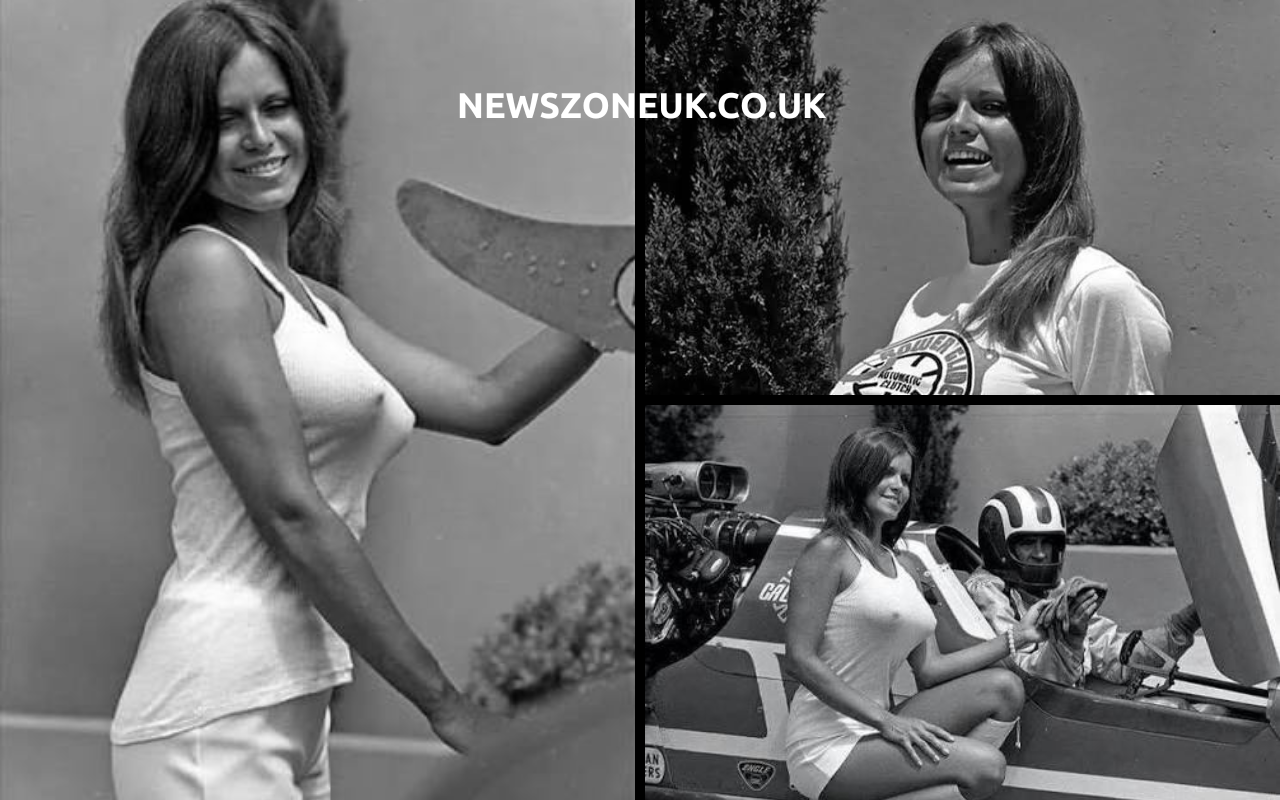
In the smoky, high-octane world of 1970s drag racing, where thunderous engines and burning rubber ruled the day, one woman stood out as an enduring symbol of glamour and grace. While the drivers captured the headlines, it was often the trophy girls who captured the hearts of the fans. Among them, Barbara Roufs became a legendary figure—an icon whose striking beauty, signature style, and warm presence left an indelible mark on the sport’s golden era. Though her time in the spotlight was relatively brief, her legacy continues to resonate with racing enthusiasts and vintage culture aficionados alike, cementing her status as a true cultural icon of Southern California’s vibrant motorsports scene.
To truly understand the phenomenon of Barbara Roufs, one must step back in time to an era when drag racing was undergoing a radical transformation. The sport was shifting from the classic hot rods of the 1960s to the more powerful, technologically advanced machines that would define the future of racing. And amidst this backdrop of change, Roufs emerged as a figure who bridged the old and the new, embodying the spirit of a generation that embraced freedom, speed, and style.
Quick Facts About Barbara Roufs
Early Life and Family Roots
Born in 1944 in Southern California, Barbara Roufs grew up immersed in the burgeoning car culture that defined the post-war American landscape . Her family had a deep connection to the world of racing and mechanics. Her father, Wayne Eldon Riley, was an avid motorcycle enthusiast who raced at the Kearney Bowl and loved spending time on his houseboat at McClure Lake . This environment fostered in Barbara a natural comfort with speed and the vibrant community that surrounded it.
Her mother, Thelma Ruby Riley, was a pillar of the community, owning a beauty salon in Clovis for five decades and serving as an organist for several churches in the area . The Rileys were a close-knit family, and their dedication to their community was recognized when they became the first couple inducted into the Clovis Hall of Fame . Barbara grew up alongside her siblings—Vivian Deaton, James Riles, Bruce Riley, and her adopted brother Ben Gube—in a home that valued hard work, service, and a love for life’s adventures. This supportive upbringing likely played a crucial role in shaping the confident and charismatic woman she would become.
The Rise of a Drag Racing Icon
Barbara’s entry into the world of drag racing was almost inevitable, given her upbringing and the allure of the Southern California racing scene. She began her career as a trophy girl and model in the late 1960s, a time when the role was evolving far beyond simply presenting winners with their prizes . These women were the face of the event, interacting with the crowd, posing with cars, and adding an element of spectacle that was essential to the sport’s appeal.
However, what set Barbara apart was her unique look and her age. At 29, she was older than many of her peers . While this might have been a disadvantage in some fields, in the world of drag racing, it gave her a mature, statuesque presence that fans and photographers adored. Her signature look—broad, straightened hair and classic 1960s go-go boots—was both nostalgic and modern, making her instantly recognizable . She became a favorite among manufacturers who used her image on branded t-shirts and in advertisements, making her face synonymous with the excitement of the sport .
Her career reached its zenith when she was crowned the queen of the 6th annual U.S. Professional Dragster Championship at the Orange County International Raceway, a venue famous for its passionate crowds . This was followed by her title as the 1973 PDA (Professional Dragster Association) queen . These accolades cemented her status not just as a pretty face, but as a beloved and integral part of the racing community.
A Lasting Legacy in the Racing World
Barbara Roufs was more than just a trophy girl; she was a trailblazer who elevated the role to an art form. During a time of significant change in the sport, she brought a sense of continuity and class to the racetracks. Many people credited her with bringing a vibrant life and energy to the drag races, which were evolving from the “golden ages” of the 60s into a more modern, high-tech era . Her presence helped to bridge the gap between the old-school fans and the new generation of enthusiasts.
Her influence extended beyond the track. As a model, her figure was used to market everything from clothing to automotive products, helping to define the aesthetic of drag racing culture for a generation. She embodied the spirit of the 1970s, a time of liberation and self-expression, and her image continues to be shared and celebrated by fans online today . She stood out as a symbol of empowerment, challenging traditional norms and showing that women could be at the center of a male-dominated environment, not just as spectators but as key figures in its success.
Personal Life and Relationships
Despite her public persona, Barbara Roufs kept much of her personal life away from the limelight. She was married, and her surname “Roufs” comes from her marriage, though the details of this relationship remain largely private . Her most widely recognized role was as a mother. She welcomed a daughter, Jet Dougherty, when she was 29 years old . The name “Dougherty” suggests a later relationship, but the identity of her partner at that time has not been publicly disclosed .
Her daughter has since become the primary voice in preserving her mother’s legacy. In 2016, when photographer Tom West posted vintage photographs of Barbara online, Jet commented on the post, paying a heartfelt tribute to her mother . She mentioned that Barbara would have been proud to see the photos, as they depicted some of the happiest days of her life . This touching moment gave fans a glimpse into the woman behind the image—a mother who was deeply loved and remembered.
The Tragedy and Enduring Mystery
Sadly, Barbara Roufs’s life came to a tragic end in January 1991. She was 47 years old . Her death was ruled as suicide, but the specific reasons behind her decision remain unclear . This tragic conclusion to such a vibrant life has added a layer of poignancy to her story. It serves as a reminder that the glamour often seen on the surface can sometimes conceal deeper, more painful struggles.
She passed away in Fresno, California, where she lived with her family . The lack of detailed information about her later years has led to much speculation, but her family has maintained a respectful silence, choosing to remember her for the joy she brought to the racing world and to their lives . Her legacy, however, is not defined by the manner of her death but by the bright light she shone during her years as a beloved figure in drag racing.
Net Worth and Financial Overview
Estimates of Barbara Roufs’s net worth vary, reflecting the different phases of her career. During the peak of her fame in the 1970s, financial information about trophy girls and models was rarely publicized. She would have earned money through event appearances, modeling contracts, and promotional work . Some sources estimate her net worth at the time of her peak to be in the range of $100,000–$200,000, which was a modest but respectable sum for the era .
In contrast, some later estimates place her net worth at around $1.5 million, though this figure is likely a reflection of the modern value of her image and legacy, rather than a direct representation of her actual earnings during her career . Today, her iconic photos are sold online as memorabilia, ensuring that her image continues to generate interest among collectors and fans . Regardless of the exact number, it is clear that Barbara’s true wealth lies in the cultural impact she left behind.
Social Media Presence and Online Community
Given that Barbara Roufs passed away in 1991, she does not have an official social media presence. However, her memory is very much alive on various digital platforms. Fans and historians regularly share her photographs, videos, and memories on sites like Facebook and Instagram. These posts are often accompanied by nostalgic commentary about the golden era of drag racing, with users frequently praising her beauty, style, and the energy she brought to the sport .
Her daughter, Jet Dougherty, has also engaged with this online community, providing personal insights and ensuring that her mother is remembered accurately . This has helped to foster a dedicated following of fans who treat Barbara Roufs not just as a historical figure, but as a beloved icon of the past. Through these digital archives, a new generation is discovering her story, learning about the culture of 1970s drag racing, and appreciating the role she played in it.
Recent Updates and Ongoing Legacy
Though decades have passed since her glory days, the fascination with Barbara Roufs has seen a resurgence in recent years. This renewed interest is largely due to the circulation of her vintage photographs on social media, which has introduced her to audiences who were not alive during her career . The mystery surrounding her life, combined with the tragic nature of her death, has made her story particularly captivating to modern audiences.
Her legacy also serves as an important piece of drag racing history. She is often cited as a source of inspiration for women who want to be involved in motorsports, proving that there is a place for women both on and off the track . As the sport continues to evolve, her contribution as a pioneer in the role of the “trophy girl” is being reevaluated. She is now seen not just as an accessory to the sport, but as a key component of its cultural fabric and a trailblazer who helped define its identity.
Conclusion
Barbara Roufs was more than just a beautiful face in victory lane. She was the heart and soul of the drag racing scene during a pivotal time in its history. Growing up in the car-centric culture of Southern California, she rose to become the most beloved trophy girl of her generation, earning titles such as the queen of the Orange County International Raceway . Her unique style, which mixed 60s glamour with 70s freedom, made her an icon, while her mature presence brought a sense of class and stability to the sport’s turbulent era of change. Though she carried the legacy of a public figure, she was also a devoted mother to her daughter, Jet Dougherty, who now helps keep her memory alive .
As Barbara Roufs continues to pave the way for future generations, her story stands as a reminder of how resilience, grace, and authenticity can build a meaningful legacy. Her journey reminds us that even in a world of loud engines and fast speeds, the most impactful presence is often the one that captivates the heart. Her life was a testament to the power of personal style and charisma, and her memory remains a source of inspiration for racing fans and women in motorsports everywhere.
Read this to: Caitlin Elizabeth Jennings: The Untold Story of Ken Jennings’ Daughter
Frequently Asked Questions (FAQs)
1. Who was Barbara Roufs?
Barbara Roufs was a famous American drag racing trophy girl and model who became a prominent figure in the sport during the late 1960s and 1970s. She was known for her striking beauty, signature style of broad straightened hair and go-go boots, and her role as the queen of several major racing championships .
2. What happened to Barbara Roufs?
Tragically, Barbara Roufs passed away in January 1991 at the age of 47 . While her death was ruled a suicide, the specific reasons and details surrounding the incident have never been publicly disclosed by her family .
3. What was Barbara Roufs’s net worth?
During her peak in the 1970s, her earnings from modeling and appearances were modest, estimated at around $100,000–$200,000. However, modern estimates sometimes place her net worth around $1.5 million, which accounts for the current value of her image and memorabilia being sold online .
4. Who is Barbara Roufs’s daughter?
Barbara Roufs had a daughter named Jet Dougherty . Jet has spoken publicly about her mother, notably commenting on vintage photos posted online in 2016 to confirm her mother’s passing and share memories of her .
5. Did Barbara Roufs have a husband?
Yes, Barbara Roufs was married. However, the identity of her husband during her most famous years is not widely known to the public, though her daughter’s surname suggests a later relationship .
6. Why is Barbara Roufs famous?
Barbara Roufs is famous for being one of the most beloved and recognizable trophy girls in the history of drag racing. She was the queen of the 6th annual U.S. Professional Dragster Championship and the 1973 PDA queen, and her image was used widely for marketing and promotions in the racing industry .